Industrial fire protection piping cannot be specified from a building-wide pipe schedule alone. A warehouse rack system, an exposed loading area, a process unit, a pump room, and a foam-water system may share a site while imposing very different demands on the pipe network. If the procurement document reduces those differences to “red fire pipe,” the result may satisfy a product description but fail the system design, local approval route, or installation conditions.
Divide the facility into protection zones, define the system and hydraulic basis for each zone, and then select the pipe standard, dimensions, material, coating, connections, and documentation as one coordinated package. This guide follows that path so project teams can turn a fire strategy into reviewable pipe requirements without treating one standard or product route as universally applicable.
Map the Industrial Fire Hazards Before Selecting Pipe
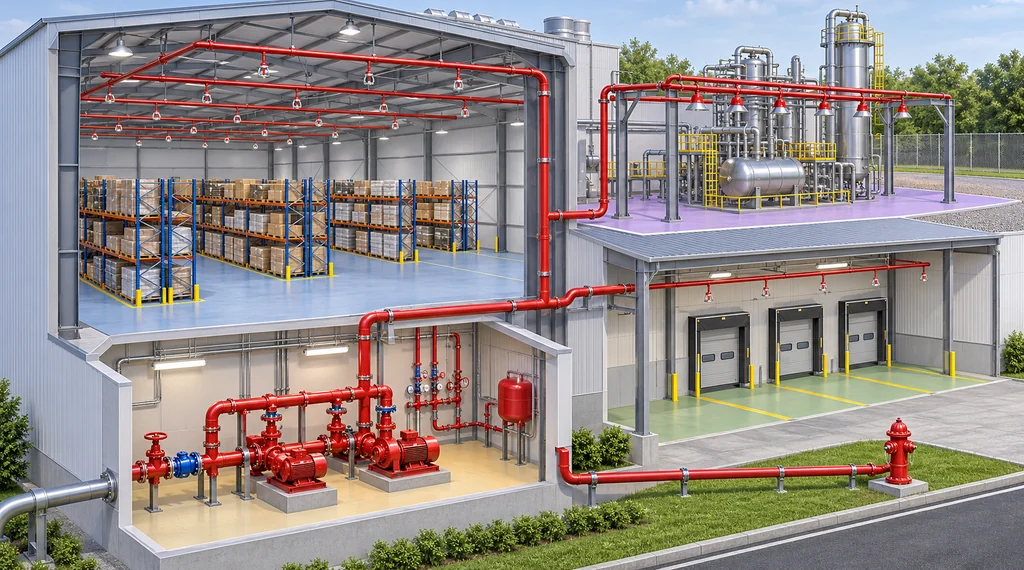
The first task is not choosing welded or seamless pipe. It is understanding what the network must protect and how the protected area can change the consequence of leakage, blockage, corrosion, or delayed discharge. Industrial sites often combine ordinary storage, high-piled or rack storage, combustible liquids, machinery, cable areas, process equipment, external yards, utilities, and occupied support buildings. Each area can require a different protection concept, discharge density, water demand, operating duration, or extinguishing medium under the governing design standard.
Create a zone schedule that identifies the occupancy or process, stored commodities, storage height and arrangement, ambient temperature, indoor or outdoor exposure, corrosive contaminants, elevation, and expected future changes. Include boundaries between fire areas and note where piping passes through spaces with different conditions. A fire sprinkler pipe for a warehouse may be governed by rack geometry and commodity changes, while pipe serving a process unit may face heat, vibration, chemical vapour, mechanical damage, or a different suppression medium. Treating both as the same application hides the conditions that should drive material and coating decisions.
The hazard map should also identify interfaces with pumps, tanks, ring mains, hydrants, monitors, deluge valves, and foam equipment. A site-wide underground main may feed systems designed under different rules, so pipe boundaries, connection interfaces, and test limits must be explicit. Otherwise, compliant packages can still arrive with incompatible dimensions, pressure classes, or ends.
Define the System Type and Hydraulic Design Basis for Each Zone
Once the hazards are mapped, assign the applicable system type. Wet-pipe sprinklers are not the default for every industrial space. Freezing exposure may lead to dry or preaction arrangements; rapid fire growth may require deluge; flammable-liquid hazards may involve foam-water systems; and outdoor networks may combine hydrants, monitors, and sprinkler supplies. The pipe must be compatible with the system medium, normal internal condition, testing regime, and operating sequence.
For each zone, record the design standard and edition, local regulatory requirements, hydraulic calculation basis, design flow, minimum and maximum working pressure, static pressure, pump shut-off pressure, surge allowance, test pressure, elevation effects, and any pressure-reducing arrangement. The controlling pipe pressure is not necessarily the pressure shown at the most remote sprinkler. Lower floors and closed valves can experience higher static or pump shut-off pressure than the hydraulically remote point. The selected wall thickness, fitting rating, valve rating, coupling, gasket, flange, and test arrangement must all cover the same controlling case.
BS EN 12845, for example, addresses the design, installation, and maintenance of automatic sprinkler systems in buildings and industrial plants, including hazard classification, water supplies, components, testing, and maintenance. Other countries and projects adopt their own national standards, insurance requirements, or approved-equipment rules. The order should name the actual project basis rather than mixing isolated clauses from several systems. Where an insurer or authority requires approved or certified components, verify the precise product, size range, connection, coating, and intended use covered by the approval; a manufacturer-level certificate or a similar product listing is not a substitute.
Convert the Design Basis Into Pipe Specifications
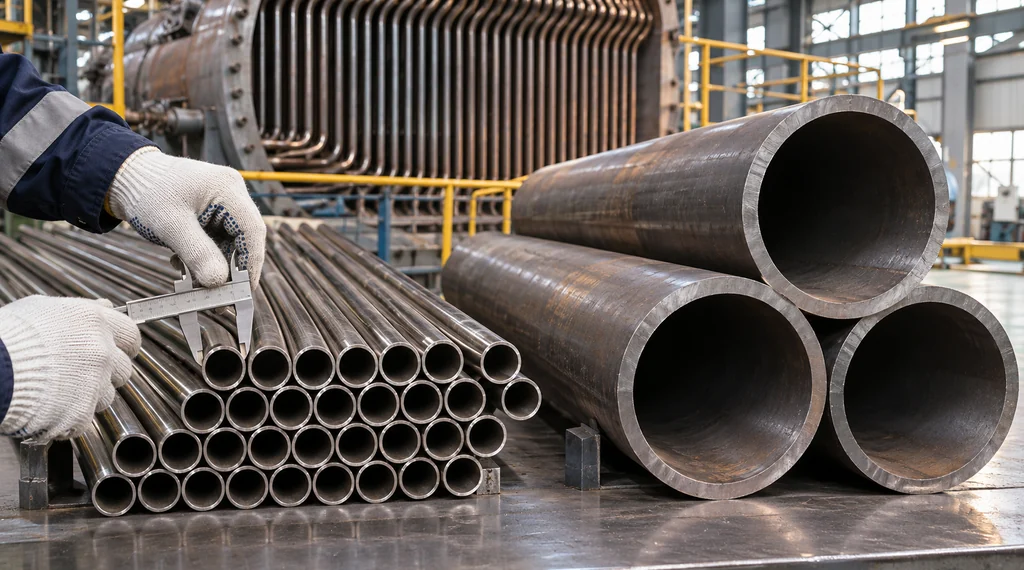
Only after the zone and hydraulic requirements are stable should the team select pipe. A complete fire sprinkler pipe specification connects the product standard and edition to the manufacturing route, grade, outside diameter, wall thickness, length, dimensional tolerances, end preparation, surface condition, marking, testing, and inspection document. Nominal size alone is insufficient because hydraulic calculations depend on internal diameter, while groove formation, threading, corrosion allowance, and mechanical loads depend on actual wall thickness and tolerances.
Welded pipe is widely used for industrial sprinkler distribution and mains when the selected product standard, dimensions, pressure, and approval route permit it. Seamless pipe may be specified for particular dimensions, higher-demand services, project conventions, or fabrication requirements, but seamless manufacture is not automatically safer. Both routes must be assessed against the same design and acceptance criteria. Buyers can review the available fire sprinkler pipe and broader fire sprinkler system ranges only after the governing basis is clear.
Product standards should follow the target market and approved project documents. An EN-based project may select an EN pipe route, while another market may specify a different national or international product standard. An EN 10217-1 ERW fire fighting pipe can be a relevant supply route where its grade, dimensions, coating, end preparation, documentation, and project acceptance align. An ASTM A135 ERW fire sprinkler pipe may be considered where that standard and any required approvals are expressly adopted. Product pages show available routes; they do not determine suitability or override local fire-system requirements.
Match Coating and Corrosion Control to the Actual Environment
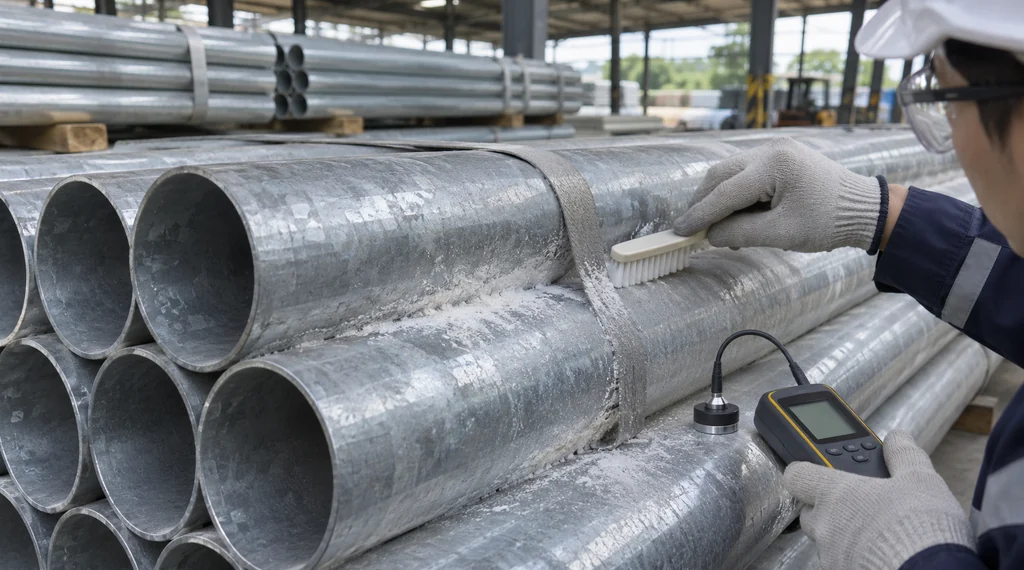
Colour is not a corrosion strategy. Red identification paint may provide limited external protection, but it does not address internal corrosion, persistent condensation, chemical exposure, marine atmosphere, buried service, or damaged field joints. Specify external and internal conditions separately, then determine whether black steel, a defined paint system, fusion-bonded epoxy, hot-dip galvanizing, another lining, or a combined corrosion-control plan is appropriate and permitted by the governing system requirements.
Internal conditions differ sharply by system. A permanently water-filled network, a dry system that admits humid air, a system with trapped water, and a foam-water line do not create the same corrosion mechanism. Water chemistry, microbiological activity, oxygen renewal, drainability, commissioning water, and long periods of stagnation can matter more than the visible external finish. Coatings and linings also introduce compatibility questions: thickness can change internal diameter; field cutting and threading can expose bare edges; some joining processes can damage the coating; and repair materials must be accepted for the service.
External exposure needs the same discipline. Pipe inside a conditioned warehouse differs from pipe in a humid pump room, washdown zone, open loading bay, or coastal plant. Define surface preparation, coating type and thickness, curing, testing where specified, permitted damage, and field repair. In corrosive areas, supports should prevent water traps and dissimilar-metal contact. Protection should extend across pipe, fittings, flanges, hangers, and repaired ends.
Coordinate Connections, Supports, and Installation Interfaces
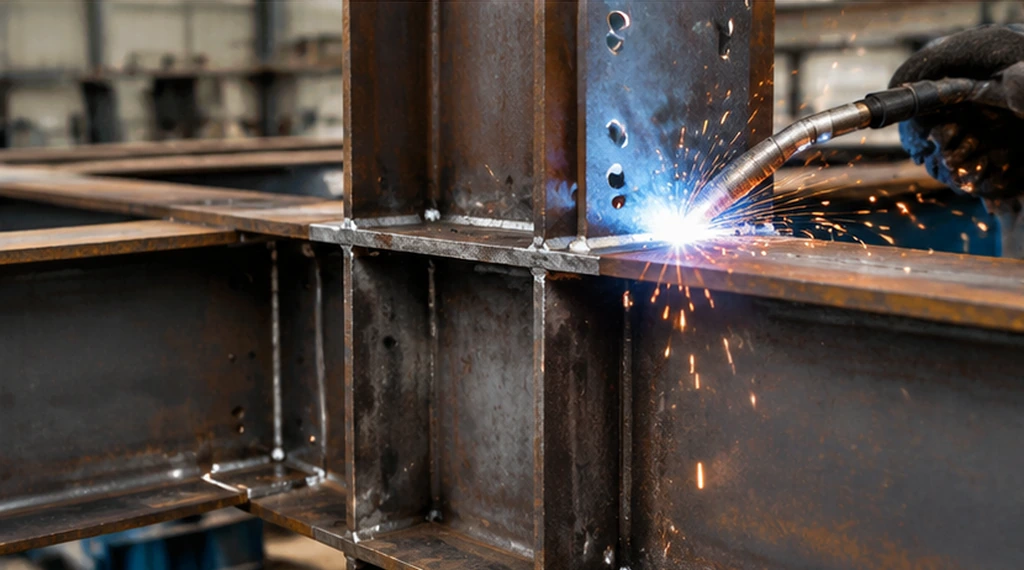
A pipe specification becomes installable only when its ends match the joining system. Grooved, threaded, welded, and flanged connections each impose different dimensional, fabrication, inspection, and maintenance requirements. Grooved systems require confirmation of outside diameter, wall thickness, groove type, coupling and gasket compatibility, and the pipe manufacturer’s ability to form the groove without unacceptable deformation. Threading removes wall material and is suitable only where the product standard, size, and minimum remaining wall permit it. Welding requires an approved procedure, compatible materials, qualified personnel, and restoration of damaged coatings.
Connection selection should also reflect industrial operations. Mechanical joints may simplify prefabrication and replacement, but the coupling and gasket must suit pressure, temperature, movement, and medium. Welded joints reduce some mechanical interfaces but can complicate work permits, coating repair, and modification in operating facilities. Flanges are useful at valves and equipment, yet their rating, facing, bolting, gasket, and drilling standard must match. The practical comparison in the article on fire sprinkler pipe connection types can support this review, but the final selection belongs in the coordinated system design.
Supports and seismic or movement provisions must be designed with the actual filled-pipe mass, valve loads, thermal movement, vibration, building movement, and local code. Do not copy a generic hanger spacing table into the purchase order without confirming the governing standard, pipe dimensions, connection type, and structural conditions. Identify prefabricated spool limits, branch outlet method, equipment nozzles, wall penetrations, inspection access, low-point drains, and slopes for systems that must drain. These details prevent a pipe purchase from being technically correct but impractical to install or maintain.
Build Inspection and Submittal Requirements Into the Order
Industrial projects often lose time after delivery because the pipe and its documents cannot be matched. The purchase order should state the inspection document type, traceability level, marking content, required certificates or approvals, manufacturing and test records, coating records, dimensional inspection, end-preparation checks, and packing list structure. Every required document should point to the same standard, grade, size, heat or batch, quantity, and product description used on the pipe marking and shipment.
The review should distinguish three questions. Is the document authentic and current? Does its scope cover the exact product, size, plant, and process supplied? Can it be traced to the delivered bundle or spool? A certificate for the wrong size range does not close an approval requirement. An MTC from a different heat does not establish material identity, and an unreferenced coating report does not prove which pipe it covers.
Before release, verify dimensional tolerances, wall thickness, straightness, ends, groove or thread condition, coating appearance and thickness where specified, marking, quantity, and packaging. Define hold and witness points early if third-party inspection is required. Packaging should keep incompatible surfaces apart, protect prepared ends, allow lifting without coating damage, and provide drainage and ventilation for galvanized material. These controls are more effective when included in the enquiry than when requested after production.
Obtain a Reviewable Industrial Fire Pipe Proposal
Baolai can compare available pipe standards, welded or seamless routes, coatings, end processing, testing, marking, and document packages against a project enquiry. The most useful enquiry includes the destination market, governing fire-system standard, zone schedule, system type, design and test pressures, pipe sizes and wall requirements, connection method, exposure conditions, coating specification, approval needs, inspection document, quantities, and delivery sequence.
Providing these inputs gives the buyer a technically comparable proposal rather than several prices built on different assumptions. It also reveals missing interfaces before production, when changes are less disruptive. For a zone-by-zone review of available industrial fire protection piping, send the hydraulic and procurement requirements together so the proposed pipe, processing, and evidence can be checked as one package.
Frequently Asked Questions
Can one pipe specification cover an entire industrial facility?
It can provide common rules, but it should include zone-specific schedules where pressure, system type, environment, medium, connection, or approval requirements differ. A single undifferentiated schedule can conceal the most important design conditions.
Is galvanized pipe always better for outdoor fire protection?
No. Galvanizing may improve external corrosion resistance, but suitability also depends on the governing standard, internal water conditions, connection method, coating continuity, atmospheric exposure, and project approval. Compare the complete corrosion-control system rather than surface appearance alone.
Must every industrial fire pipe have third-party product approval?
Not universally. Approval or listing requirements come from the adopted code, insurer, client specification, and local authority. When required, confirm that the approval covers the exact product, size, connection, coating, and use being supplied.
What information should be frozen before requesting a quotation?
At minimum, freeze the destination market, design standard, system and hazard zones, pressure basis, dimensions, product standard, joining method, coating, approval route, testing, documentation, quantities, and delivery sequence. Clearly label any unresolved item as a supplier query rather than allowing an assumption to become part of the order.
Sources
BSI: BS EN 12845, Fixed firefighting systems — Automatic sprinkler systems
ISO 6182-12:2010, grooved-end components for steel pipe systems