Steel pipe heat treatment is not simply a furnace step added after forming. The selected thermal cycle changes the microstructure, hardness, strength, toughness, residual stress, and suitability for later fabrication. Ordering “heat-treated pipe” without naming the required delivery condition can therefore produce material that is fully documented yet unsuitable for the intended service.
The correct route starts with the product standard, steel grade, dimensions, service conditions, and required properties. These inputs determine whether annealing, normalizing, quenching, tempering, or a combined treatment is permitted or required. This guide explains the four treatments, how they differ, and which production records allow a buyer to verify the delivered condition.
Start With the Required Steel Pipe Delivery Condition
Heat treatment should come from the applicable product standard and purchase specification, not a generic process list. The same name can represent different temperatures, holding times, cooling rates, or purposes by composition and product. Different pipe families do not share one universal thermal cycle.
Identify the grade, dimensions, manufacturing route, service temperature, design properties, weldability needs, and required tests. Record the permitted delivery condition exactly as defined by the governing specification. A normalized designation is not satisfied merely because the pipe cooled in air during manufacture.
This distinction matters for seamless steel pipe options. Hot forming and cold drawing leave different conditions, while final treatment may restore ductility, refine grain, or obtain specified properties. Seamless manufacture does not automatically deliver a preferred microstructure.
Compare Annealing, Normalizing, Quenching, and Tempering
All four processes control heating and cooling, but they pursue different outcomes. Their practical differences are easier to see when compared by purpose, cooling route, typical result, and main procurement risk.
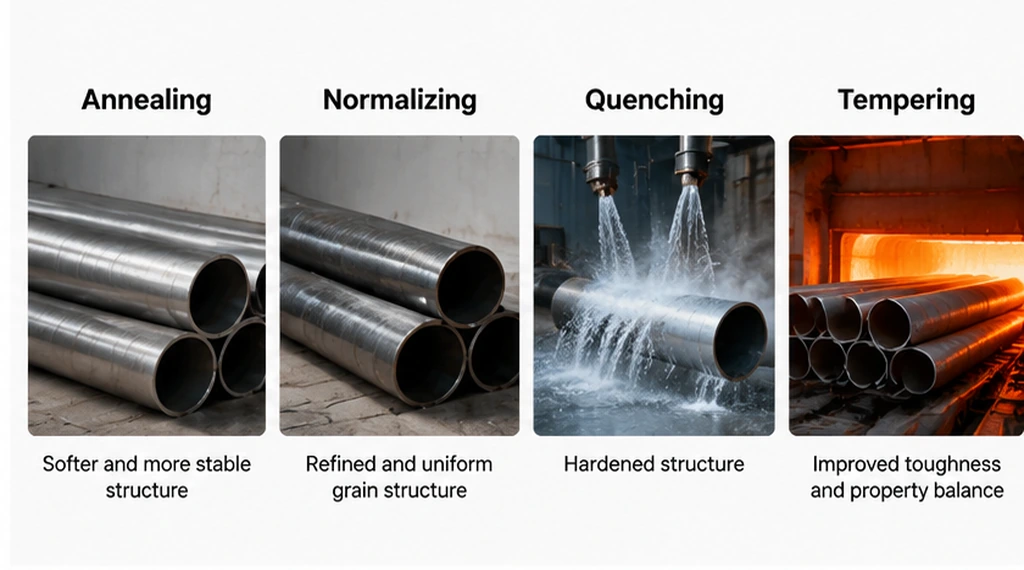
| Treatment | Main purpose | General cooling approach | Typical procurement concern |
|---|---|---|---|
| Annealing | Move the steel toward a softer or more stable condition, reduce stress, or support forming and machining | Controlled cooling selected for the specific annealing process | “Annealed” is too broad unless the annealing type and required properties are defined |
| Normalizing | Refine and homogenize the structure after heating above the transformation range | Cooling in air under controlled conditions | Air cooling alone does not prove that the required normalizing cycle occurred |
| Quenching | Cool faster than still air to produce a hardened or transformation-controlled condition | Water, oil, gas, polymer, or another specified medium | Excessive severity or uneven cooling can create distortion, high stress, or cracking risk |
| Tempering | Reheat previously hardened steel below the transformation temperature to obtain the required property balance | Controlled cooling after one or more tempering holds | Tempering cannot be assessed without the preceding condition and final test results |
Annealing Supports Softening, Stress Control, or Structural Adjustment
Annealing is a family of treatments rather than one fixed recipe. Depending on the purpose, it may reduce hardness, improve machinability, restore ductility after cold work, relieve residual stress, dissolve selected constituents, or create a more stable structure. Full annealing, stress relieving, recrystallization annealing, and solution annealing are not interchangeable terms.
For pipe procurement, the buyer should ask what problem the annealing cycle is intended to solve. Cold-drawn tube may need treatment to recover formability; austenitic stainless pipe may require solution treatment; another product may need only stress relief. The order should name the required condition and acceptance properties rather than relying on the word “annealed.”
Normalizing Refines and Homogenizes the Steel Structure
Normalizing heats the steel into the applicable transformation range and then cools it in air to obtain a refined, more uniform structure. Compared with a slow full-annealing cycle, normalizing generally produces a different ferrite-pearlite condition and property balance. The result still depends on grade, section thickness, furnace uniformity, and cooling conditions.
Normalizing is often selected when the product specification requires a controlled grain structure and mechanical properties after hot working. It should not be inferred from surface appearance. The furnace chart, batch identity, delivery-condition marking, and mechanical test results must support the claim.
Quenching Creates a Hardened Condition That Requires Tight Control
Quenching means cooling more rapidly than in still air. In steels intended for quench hardening, the cycle can form martensite and sometimes bainite, increasing hardness and strength. The cooling medium and agitation, transfer time, pipe geometry, steel hardenability, and starting temperature all affect the result.
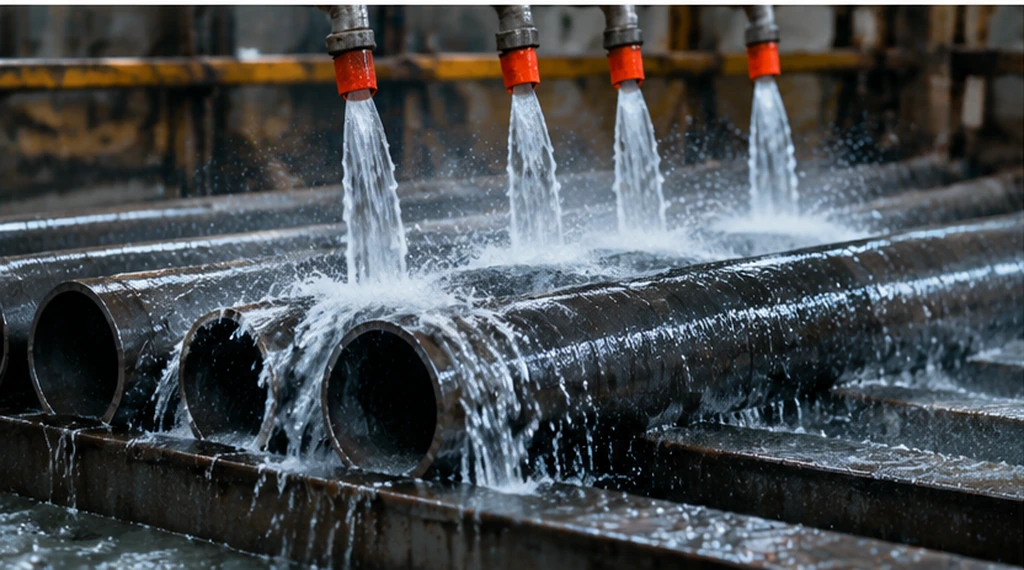
Rapid cooling can also introduce high residual stress, distortion, or cracks if the cycle is unsuitable or uneven. Thin- and thick-walled pipes may respond differently, and the inner and outer surfaces may not cool at the same rate. A buyer should therefore verify that the qualified cycle covers the ordered dimensions and that inspection addresses straightness, hardness, surface condition, and any specified nondestructive examination.
Tempering Converts Hardness Into a Usable Property Balance
Tempering normally follows quench hardening. The steel is reheated below the main transformation temperature, held as required, and cooled under controlled conditions. This reduces brittleness and adjusts hardness, strength, toughness, and dimensional stability toward the required balance.
“Quenched and tempered” must be treated as one delivery route, not two unrelated certificates. A tempering record without evidence of the preceding austenitizing and quenching cycle is incomplete. Likewise, a compliant furnace chart does not replace final tensile, impact, hardness, or other tests required by the product specification.
Connect the Heat Treatment to Pipe Properties and Service
Heat treatment does not improve every property at once. Greater strength may reduce ductility or complicate welding, while a soft forming condition may miss the final strength requirement. The target is the property set required by the product standard and design, not maximum hardness.
Chemistry influences hardenability, transformation, tempering response, and weldability. Dimensions affect heating uniformity and cooling through the wall. Service then determines which properties matter: low-temperature work may emphasize toughness, elevated-temperature service may require stability, and later bending or welding may limit hardness.
Do not assume that a nominally similar grade from another standard will respond identically. Product standards may impose different compositions, delivery conditions, heat-treatment routes, test temperatures, or sampling rules. The steel grade equivalents guide can help identify comparison questions, but the project must approve any substitution against the complete specification.
Verify the Heat Treatment Through Production Records and Tests
Acceptance requires a traceable link from the order to the furnace batch and finished pipe. Before production, the manufacturer should have an approved route defining the applicable equipment, loading arrangement, temperature range, holding basis, cooling method, and required checks. The level of detail disclosed to the buyer depends on the contract, but the evidence must be sufficient to verify the ordered delivery condition.
The review normally connects these records:
- Purchase order, product standard, grade, dimensions, and required delivery condition
- Heat or batch identity and pipe marking
- Furnace identification, calibrated sensors, cycle chart, and treatment date
- Quenching medium or cooling method where applicable
- Mechanical, hardness, impact, metallographic, or nondestructive test results required by the specification
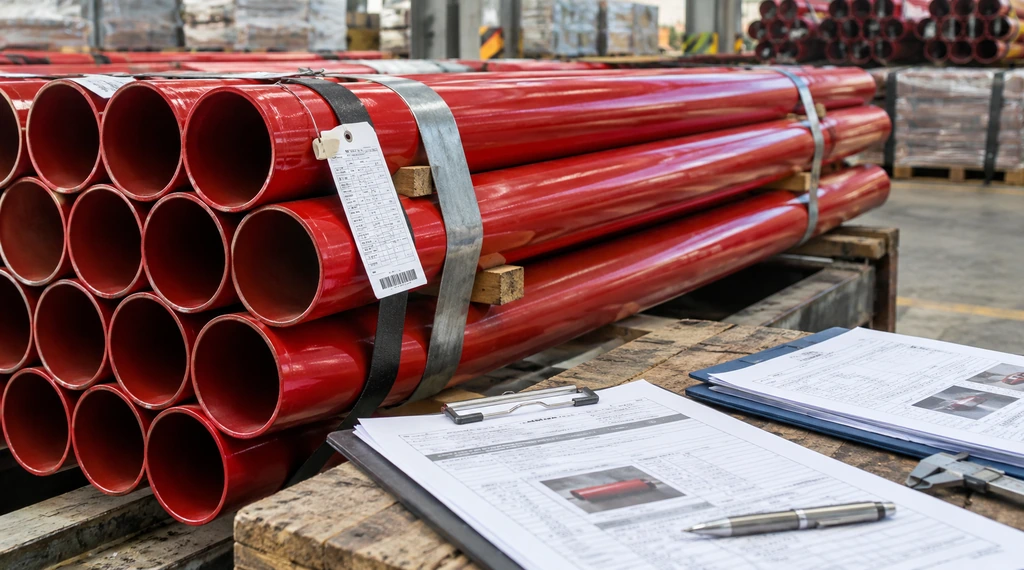
- MTC and final inspection release referencing the treated batch
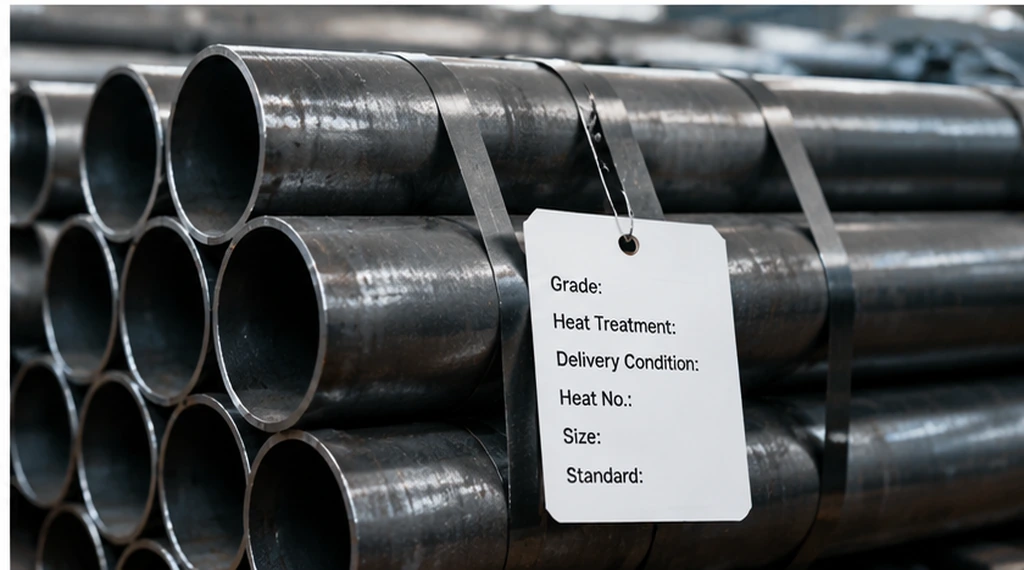
These are not independent paperwork items. The heat number on the pipe should lead to the MTC, the MTC should identify the delivery condition, and the treatment record should cover that same batch. Test results then confirm whether the process achieved the specified properties. If one link is missing, additional pages from another batch do not close the gap.
For example, an API 5L carbon seamless line pipe may be available in several grades and specification levels, but the ordered edition, grade, product specification level, dimensions, and delivery condition must be confirmed together. A product page identifies a supply route; it does not replace the project specification or batch documentation.
Resolve Heat Treatment Mismatches Before Accepting the Pipe
When documentation is inconsistent, first determine whether the issue is clerical, evidential, or technical. A missing reference on a certificate may be correctable if the manufacturer can restore traceability. A furnace chart from another heat is not evidence for the delivered batch. A delivery condition different from the order may affect the material itself and requires formal engineering review, not a revised file name.
Retesting can confirm selected final properties, but it does not automatically prove that the specified process route occurred. Reheat treatment may be possible for some products, yet it can alter dimensions, surface condition, grain structure, or previously achieved properties. Any reprocessing should follow the governing standard, an approved procedure, and renewed inspection. Material should remain on hold until the buyer can connect the accepted disposition to the exact pipe quantity.
Confirm Steel Pipe Heat Treatment Before Ordering
Baolai can review available pipe grades, manufacturing routes, delivery conditions, and supporting production documents against an enquiry. Buyers obtain a clearer comparison when they provide the governing standard and edition, grade, dimensions, service conditions, required heat treatment, tests, inspection document, and marking requirements.
This information helps expose differences between a requested delivery condition and a supplier’s available route before production begins. To reduce the risk of receiving pipe with the right grade name but the wrong treatment or evidence, confirm the required steel pipe heat treatment as part of the technical order review.
FAQs
Is normalized steel pipe the same as normalizing rolled pipe?
No. Normalized and normalizing-rolled conditions are produced through different process routes and should not be treated as interchangeable unless the governing specification and project approve them. Check the exact delivery-condition designation and supporting records.
Can hardness testing alone verify quenching and tempering?
No. Hardness can support acceptance, but similar hardness values may arise from different structures and cycles. Verify the heat-treatment record, batch identity, required mechanical tests, and any specified microstructure or NDT evidence.
Does welding remove the benefit of the original heat treatment?
Welding creates a heat-affected zone whose properties can differ from the parent pipe. Whether post-weld heat treatment is required depends on the material, thickness, service, welding procedure, and applicable code. Use the approved fabrication specification rather than extending the mill treatment rule automatically.
Can a buyer specify a custom heat-treatment temperature?
Only with appropriate technical control. Temperature cannot be selected independently of steel chemistry, transformation behaviour, dimensions, cooling route, and property requirements. A custom cycle needs manufacturer review and project approval before production.