Structural steel purchasing can fail even when the total tonnage and quoted grade appear correct. A section may follow the wrong dimensional series, a substitute grade may lack the required toughness or weldability evidence, or fabricated members may arrive without approved welding and inspection records. These gaps create redesign, site fitting, delayed erection, and uncertain traceability.
The solution is to connect the design basis to every procurement and inspection decision. Buyers need to freeze the grade and section designation, define tolerances and processing, approve fabrication documents, preserve heat traceability, and inspect the finished shipment against the same requirements. This checklist follows that path from enquiry to release.
Freeze the Structural Design and Procurement Basis
Procurement should start from approved drawings, member schedules, connection details, and project specifications. A material list may omit the design standard, execution requirements, environment, protection, toughness class, inspection level, or substitution limits. Selecting the nearest stock item cannot safely resolve these gaps.

For each member, identify its function, complete section designation, grade, delivery condition, length, finish, connection, and fabrication scope. The design engineer remains responsible for adequacy; the buyer translates the approved design into an unambiguous order and evidence package. Reconcile conflicting documents before purchase rather than leaving the fabricator to choose.
Where several design systems appear, state the governing standard and edition for each product and activity. Grade names, profile families, bolts, and welding requirements may follow different references. “International standard steel” cannot control dimensions, tolerances, testing, or acceptance.
Match Every Grade and Section to an Approved Design Item
The first material check is identity. A complete designation normally combines the product form, dimensional series, nominal size, grade, subgrade or toughness class where applicable, and delivery condition. For a fabricated item, the drawing mark and piece number must also remain visible through cutting, drilling, welding, coating, and packing.
Do not approve substitution from yield strength alone. Composition, thickness-dependent properties, impact conditions, through-thickness requirements, weldability, delivery condition, and certification can differ. Compare proposed equivalents clause by clause and obtain project approval before production.
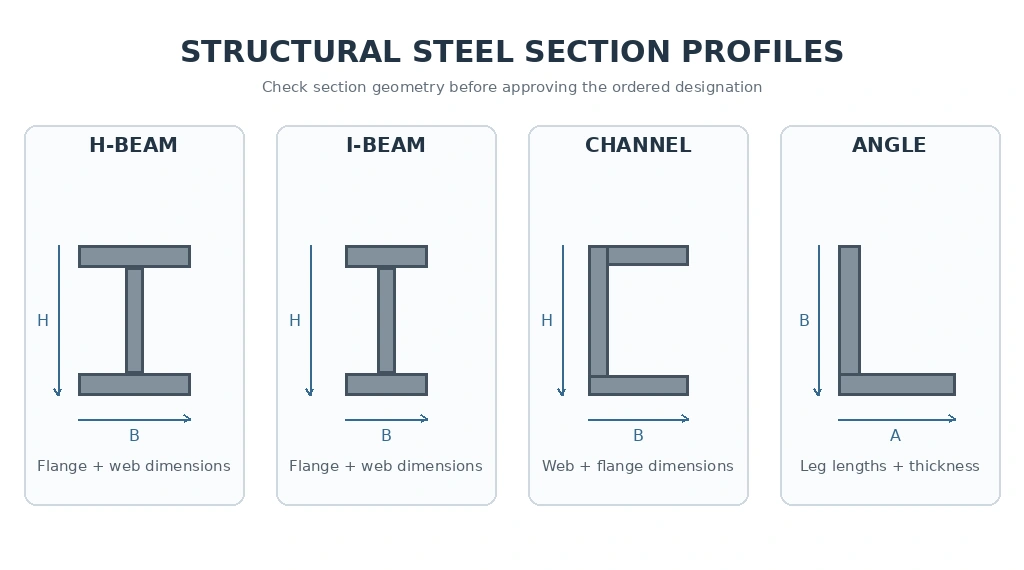
H-beams, I-beams, channels, and angles are not interchangeable because nominal depth is similar. Flange and web dimensions, root radius, mass per metre, axis properties, and face geometry affect capacity and fit-up. The section steel selection guide explains the profiles; procurement must still follow the approved series.
Define Steel Section Tolerances Before Comparing Quotations
Nominal dimensions are not acceptance limits. Product standards may control section depth, flange width, web and flange thickness, out-of-square, straightness, mass, and length through separate tolerances. Fabrication drawings may add tighter requirements at base plates, splices, bolt groups, bearing surfaces, or interfaces with cladding and equipment.
Separate three tolerance layers. Mill tolerances govern the product; fabrication tolerances govern cutting, drilling, welding, and assembly; erection tolerances govern the installed frame. Mill tolerance cannot justify a fabricated connection that misses approved dimensions, and site adjustment should not cure avoidable shop error.
Use a requirement map so quotation and inspection teams apply the same reference:
| Controlled feature | Governing evidence | Procurement effect | Inspection action |
|---|---|---|---|
| Section dimensions and mass | Product standard and section table | Confirms the ordered profile series | Measure sampled sections and verify markings |
| Cut length and end preparation | Member schedule and fabrication drawing | Controls fit-up and splice location | Measure before release to fabrication or shipment |
| Hole size, pitch, and edge distance | Approved connection drawing | Controls bolted assembly | Check against the piece mark and drawing revision |
| Camber, straightness, and sweep | Project fabrication criteria | Affects erection and alignment | Record actual geometry using the specified method |
| Welded assembly dimensions | Approved drawings and applicable fabrication tolerance standard | Controls interfaces between members | Inspect after welding and before coating |
State how measurements are taken and conformity is decided. Member support, surface condition, location, and instrument capability can affect results. Reports should tie each result to a feature, method, drawing revision, and acceptance limit.
Approve Welding and Fabrication Documents Before Work Starts
When supply includes cutting, drilling, welding, or built-up members, procurement becomes a fabrication-quality task. Before production, identify the welding quality requirements, approved procedures and qualifications, personnel qualifications, consumables, joint details, thermal controls where required, and inspection plan.
These documents answer different questions. The procedure controls how to make the joint; its qualification supports that procedure; personnel qualifications identify who may weld; and the inspection plan defines examination and acceptance. One cannot replace the others.
Preparation must remain within the design. Thermal cutting, hole enlargement, weld repair, flame straightening, or attachment removal can change geometry or local properties. Define permitted methods, repair approval, and reinspection. Resolve any special heat treatment, toughness, or through-thickness requirements before release.
Build Traceability From Mill Material to Finished Members
Traceability should survive every fabrication step. The mill certificate identifies the heat and product, but it becomes ineffective if marks disappear during cutting or pieces from several heats are mixed without transfer records. The fabricator needs a documented system connecting incoming material, heat numbers, cutting plans, piece marks, weld maps where required, inspection reports, coating records, and packing lists.
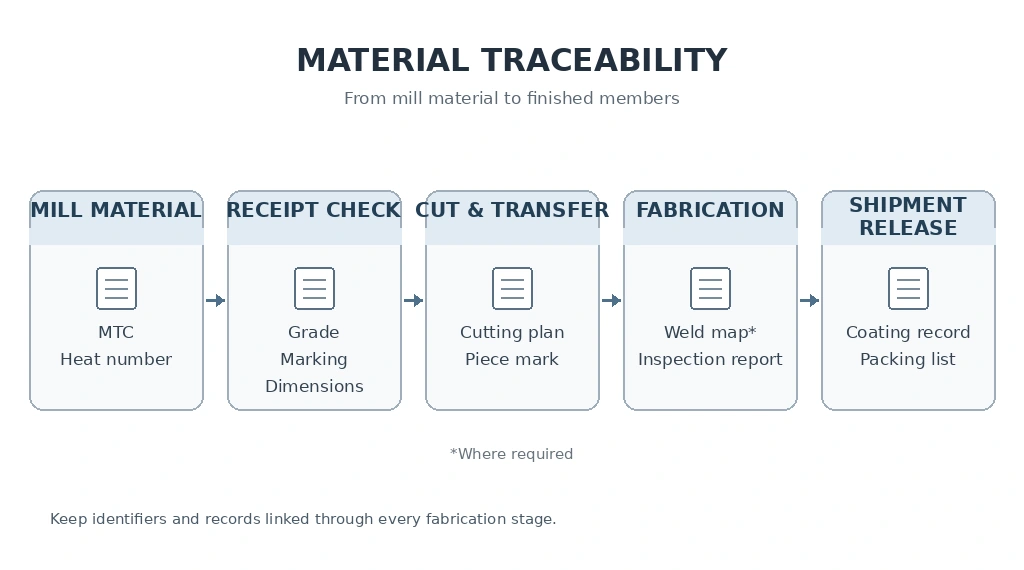
At receipt, compare certificates with items, markings, dimensions, quantity, and grade. During fabrication, transfer identifiers and record the parent material for each member. At release, packing lists and marks should identify each item and retrieve its records. Agree the traceability level before processing.
Check document scope. One heat certificate cannot cover unrelated material, and a sample report should identify its represented batch. Specify the required inspection-document type and validator; “MTC available” does not establish material-specific results or independent validation.
Inspect Fabricated Structural Steel Against the Approved Package
Final inspection should follow the manufacturing sequence rather than occur only after coating hides the work. Incoming material identity and condition are checked first. Dimensional and fabrication checks follow cutting and drilling. Weld visual inspection occurs before additional NDT, and specified NDT is performed with qualified procedures and personnel. Surface preparation, coating, marking, packing, and document review complete the release.
The NDT method and extent should follow the project, joint category, material, thickness, welding process, and quality level. Visual, magnetic particle, penetrant, ultrasonic, and radiographic testing detect different discontinuities and are not interchangeable. Define acceptance and reporting before examination.
A useful release decision links the finding to an action. An incorrect mark requires restored traceability. An out-of-tolerance hole pattern may need engineering disposition or replacement, not site forcing. An unacceptable weld requires an approved repair, reinspection, and closure record. Coating damage needs repair under the coating procedure and verification before packing. Material with unresolved nonconformities should remain segregated and clearly identified.
Control Substitutions, Nonconformities, and Document Revisions
Changes must remain controlled. A request to substitute grade, section, connection, weld process, fastener, or finish should state the reason and impact. Obtain approval from the contractual authority before production; workshop verbal acceptance is not a reliable inspection basis.
Nonconformance records should identify the member, requirement, actual condition, disposition, approval, corrective work, and reinspection. “Use as is,” repair, rework, and rejection require appropriate authority. The final index should show current revisions and closed actions.
Before shipment, verify that closed records match the delivered piece marks and quantities. This final reconciliation is what turns separate certificates, drawings, and reports into a reviewable structural steel package.
Issue a Complete Structural Steel Purchase and Release Package
The final order should state the governing project documents, section designations, grades and delivery conditions, quantities, lengths, processing, tolerances, welding scope, surface protection, inspection, certification, marking, packing, and permitted substitutions. Hold and witness points should be clear enough that material is not processed or shipped before required review.
The commercial schedule should use the same item numbers as the technical schedule. This allows quotation comparisons, production status, inspection release, packing, and site receipt to follow one consistent member identity.
For projects still selecting profiles, current structural steel products provide a route to relevant section families. A project specifying that product standard may also review an A36 H-beam product route, but the page does not replace approved structural calculations, drawings, or project certification requirements.
Review Structural Steel Procurement Requirements
Baolai can review available structural sections, processing routes, and supporting production documents against a defined enquiry. Buyers should provide the governing standards, approved member schedule, full section and grade designations, lengths, fabrication drawings, welding and coating scope, tolerances, inspection plan, document type, marking, and packing requirements.
Confirming these inputs early gives the buyer a consistent basis for comparing offers and helps expose missing tolerances, incompatible profile designations, or incomplete inspection evidence before material reaches the site. Discuss the required structural steel procurement before finalizing the order package.
Frequently Asked Questions
Can a supplier substitute a heavier section without design approval?
Not automatically. A heavier section can change dimensions, connection geometry, self-weight, load paths, fire protection, and erection interfaces. The responsible design authority should review the complete proposed substitution before purchase or fabrication.
Is an MTC enough to approve fabricated structural steel?
No. The MTC supports material identity and test results, while fabricated steel may also require approved drawings, traceability records, welding documents, dimensional reports, NDT results, coating records, and nonconformance closure. Check the complete project document schedule.
Should every structural weld receive ultrasonic or radiographic testing?
No. The method and extent depend on the project specification, joint type, material, thickness, welding process, consequence, and applicable quality requirements. Define the examination plan and acceptance criteria before welding begins.
When should section dimensions be checked?
Check incoming sections before fabrication and critical assembly dimensions after processing and welding. Early checks prevent nonconforming stock from entering production; final checks confirm that cutting, holes, weld shrinkage, and straightening have not moved the member outside acceptance limits.