A steel grade substitution should be approved only when the proposed material is shown to satisfy the original product scope, governing standard, dimensions, delivery condition, chemistry, mechanical and service properties, fabrication requirements, inspection evidence, and project approval route. Similar names, comparable yield strength, or a row in an equivalency chart are not enough. The practical method is to freeze the original requirement, eliminate candidates from the wrong product family, compare every decision-critical difference, verify the material that can actually be supplied, and record the authorized result before ordering.
Verification must begin with the original requirement and end with a controlled purchase order. Between those points, the buyer and responsible technical parties need to compare the governing standards, product scope, chemistry, mechanical properties, service conditions, fabrication effects, actual supply evidence, and approval route. This process turns a possible equivalent into an auditable accept, conditional accept, request for more information, or rejection decision.
Freeze the Original Steel Requirement Before Comparing a Substitute
Start with the material that was actually specified, not a shortened grade name copied from an email. Identify the contract document, drawing, material schedule, product standard and edition, full grade and quality level, product form, dimensions or thickness range, delivery condition, heat treatment, manufacturing route, coating, testing, certification, and intended service. Record any supplementary requirements and approved deviations that modify the base standard.
Create a baseline sheet that separates mandatory requirements from purchaser options and project additions. For every item, record the controlling document, clause or drawing reference, required value or condition, and responsible approver. Resolve conflicts before comparing the candidate: a later approved project specification may modify a base standard, while an informal email should not silently override a controlled drawing or material schedule. This baseline gives the substitution review one stable target and prevents the proposed material from being judged against whichever requirement is easiest to meet.
Eliminate Candidates That Match the Grade Name but Not the Product
The first filter is product scope. Confirm that the proposed grade is specified for the same type of product: pipe or tube, plate, sheet, coil, bar, structural section, casting, or forging. A chemistry or strength match across different product forms does not establish equivalence because manufacturing, dimensional tolerances, surface requirements, test specimens, heat treatment, and acceptance rules may differ.
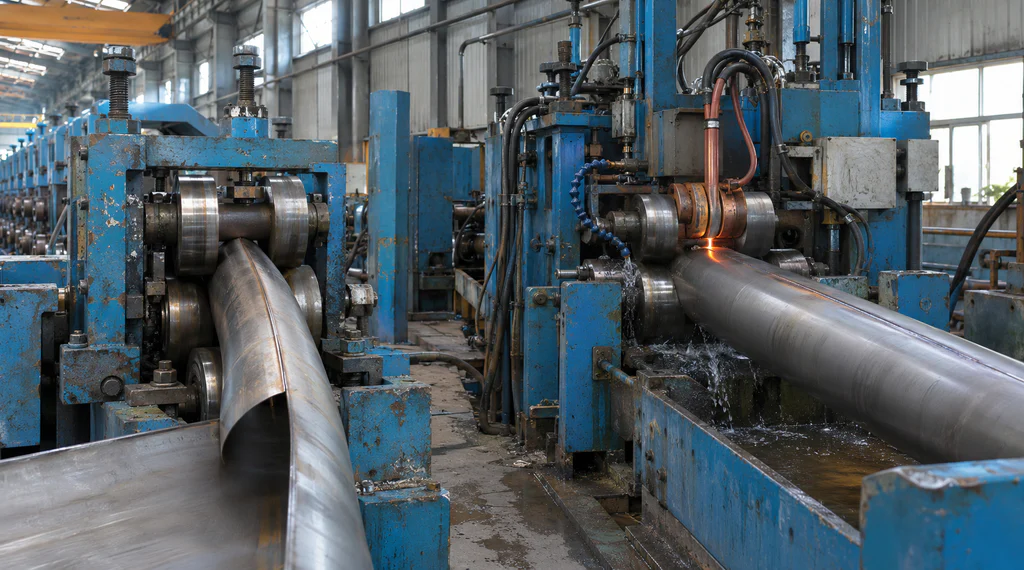
Next check the manufacturing route and delivery condition. Welded and seamless pipe are not interchangeable descriptions; hot-finished and cold-formed structural products may use different properties and tolerances; normalized, normalized-rolled, thermomechanically rolled, quenched and tempered, and as-rolled conditions can affect toughness, weldability, and fabrication. If the candidate does not exist within the required product standard, size, thickness, and condition, stop before performing a detailed numerical comparison.
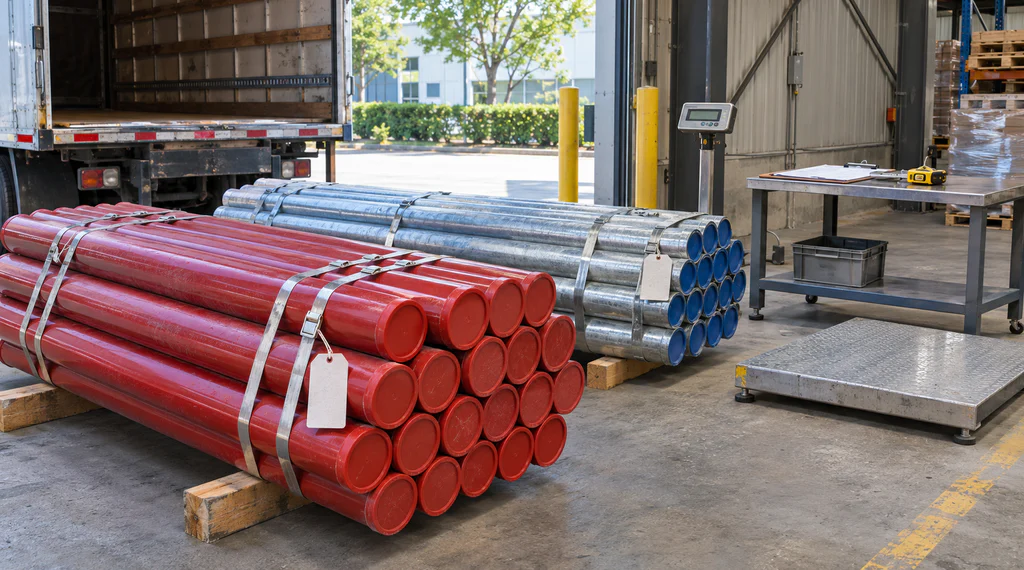
The welded steel pipe category and seamless steel pipe category illustrate why the product family must be fixed before grade comparison. They are commercial routes, not evidence that grades across those routes are equal. The approved application and product standard decide which family can be considered.
Compare the Governing Standards Clause by Clause
A grade table is only a starting point. Obtain the controlled editions of the original and proposed product standards and compare their scopes, definitions, grade designations, manufacturing routes, delivery conditions, dimensional ranges, tolerances, chemical requirements, mechanical tests, retest rules, inspection documents, marking, and purchaser options. Note whether each requirement is mandatory, optional, or triggered by the order.
Pay attention to the basis behind each value. One standard may report minimum yield strength for a particular thickness range while another changes the minimum as thickness increases. Tensile specimens, orientation, gauge length, impact-test temperature, sampling frequency, and acceptance criteria can differ. Copying two headline values into a spreadsheet can hide these conditions and produce a false match.
The comparison should show four elements for every material requirement: the original requirement, the proposed requirement, the documented difference, and the effect on the decision. If a difference has no effect, explain why. If it changes design, fabrication, inspection, cost, or lead time, identify the responsible reviewer and required action. Blank cells, “equivalent,” or “better” are not technical justifications.
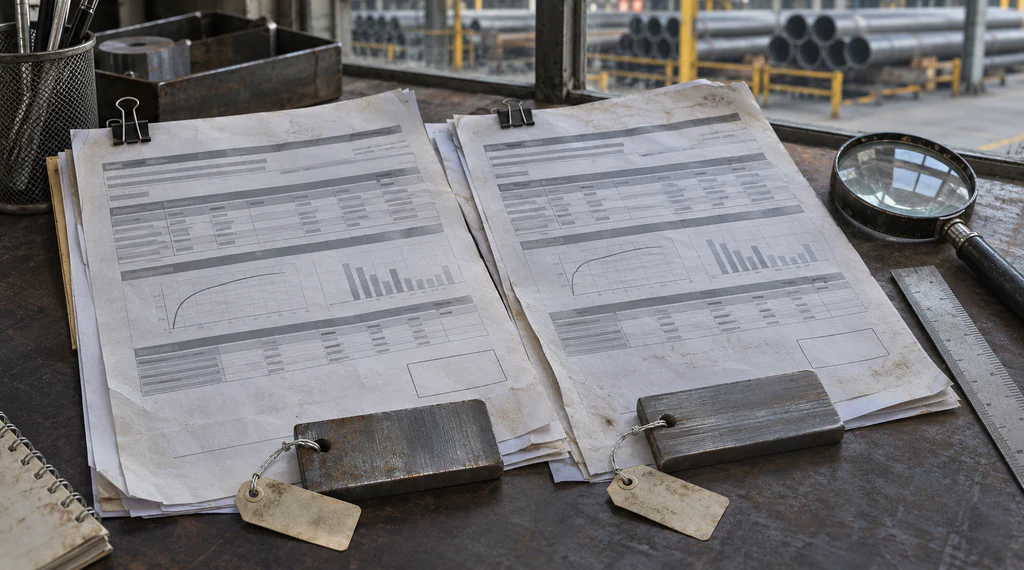
Compare Chemistry, Mechanical Properties, and Service-Critical Requirements
Chemical Composition and Carbon-Equivalent Controls
Compare the specified heat and product analyses for carbon, manganese, silicon, phosphorus, sulfur, microalloying elements, residuals, and any application-specific limits. Determine whether the values are maxima, ranges, or reporting requirements. A lower carbon value alone does not prove better weldability when alloying elements, thickness, delivery condition, and the carbon-equivalent formula differ.
Where the project uses carbon equivalent, crack-susceptibility parameters, or welding groups, apply the formula and limits required by the governing documents. Do not calculate one standard’s value and judge it against another standard’s limit without confirming that the formula, product analysis, thickness, and condition are comparable. Differences may require a revised welding review rather than an automatic rejection, but they must remain visible.
Strength, Ductility, and Test Direction
Compare yield or proof strength, tensile strength, elongation, reduction of area where relevant, hardness limits, and the applicable thickness ranges. Confirm whether the reported value comes from longitudinal or transverse specimens and whether the standard changes specimen geometry or gauge length. A candidate with higher minimum yield strength may also have a different strength ratio or ductility expectation that affects forming, connection behaviour, or design assumptions.
Avoid the common rule that a stronger grade can always replace a weaker one. Higher strength may change weld procedures, bend radii, bolt or connection behaviour, forming loads, springback, or the intended capacity hierarchy. The designer must decide whether those changes are acceptable for the specific component.
Toughness, Temperature, and Other Service Conditions
If brittle-fracture resistance matters, compare impact-test temperature, specimen size, orientation, minimum energy, averaging rules, and thickness. A grade tested at room temperature is not automatically equivalent to one qualified for low-temperature service. For elevated temperature, sour or corrosive service, cyclic loading, fire exposure, or pressure containment, identify the additional properties and standards that control the decision.
Check How the Substitute Affects Welding, Fabrication, and Interfaces
Material equivalence is partly a fabrication question. Confirm whether the current WPS and supporting qualification cover the proposed material group, thickness, delivery condition, and process. Review preheat, consumables, heat input, interpass temperature, post-weld heat treatment, hardness, and inspection requirements where applicable. A supplier cannot approve a welding change simply by offering an MTC with acceptable tensile values.
Then review forming, bending, expanding, grooving, threading, machining, cutting, galvanizing, and coating. Chemistry, strength, surface condition, heat treatment, and tolerances can affect each operation. If the substitution changes outside diameter, wall thickness, plate thickness, section geometry, or mass, check mating components, supports, flanges, fittings, clearances, loads, transport, and installation drawings.
Verify the Proposed Supply With Current Certificates and Batch Evidence
A theoretical candidate must exist as a real, controllable supply. Verify the mill, product standard, grade, size or thickness, delivery condition, manufacturing route, test availability, marking, inspection document type, quantity, and lead time. Review a representative MTC format, but remember that a sample certificate does not prove the chemistry and properties of a future heat.
When a project compares a welded and seamless route under related international product standards, current pages such as EN 10217-1 welded pipe and EN 10216-1 seamless pipe can help identify available product paths. They do not establish grade equivalence or project acceptance; the exact order and batch documents must still close the comparison.
Confirm what evidence will accompany production: MTC, heat treatment records, nondestructive examination, dimensional reports, coating records, third-party inspection, or other project documents. The certificate must be traceable to the delivered heat or batch. A product certificate or quality-management certificate cannot replace actual material-test results.
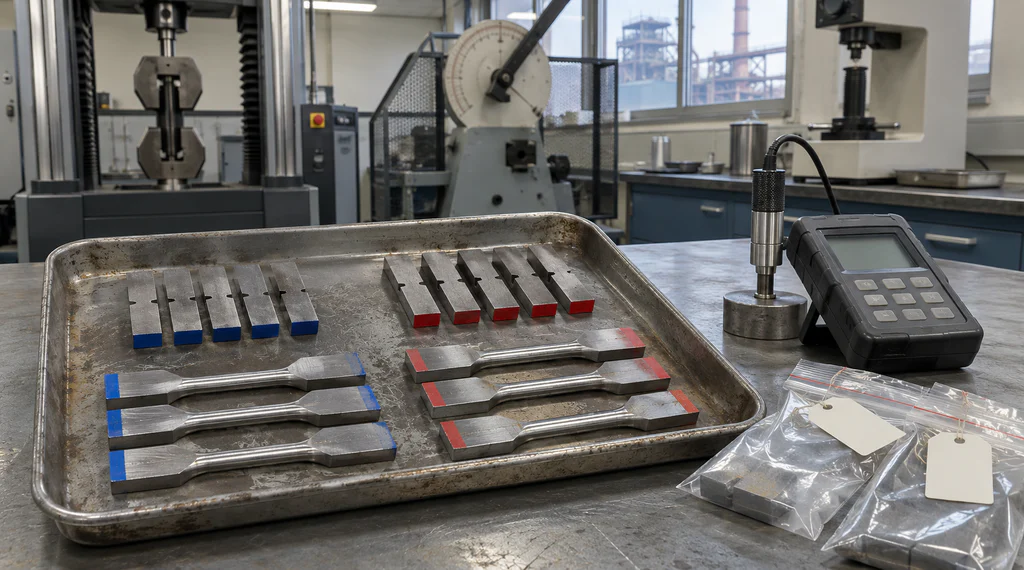
Submit a Steel Material Substitution Request That Supports a Decision
A reviewable request should identify the original requirement and exact affected quantity, then describe the proposed standard, edition, grade, product form, dimensions, delivery condition, and manufacturing route. Attach the clause-by-clause comparison, technical data, representative certificates, and current supply evidence. State every known deviation rather than presenting only matching properties.
Explain the effects on design, service, welding, fabrication, coating, inspection, interfaces, cost, and delivery. Identify which drawings, bills of material, WPSs, ITPs, calculations, or submittals require revision. The request should end with a clear decision sought: approve as proposed, approve subject to listed conditions, request additional evidence, or reject.
Control revisions and responses. Informal comments such as “looks equivalent” should not release procurement when the project requires formal approval. If supplementary testing or a procedure qualification is a condition, specify who performs it, which acceptance criteria apply, and whether purchase may begin before successful completion. Commercial urgency should be disclosed, but it is not technical evidence.
Record the Approved Substitution in the Purchase Order
After approval, update the purchasing and technical records so the supplier does not receive conflicting instructions. The purchase-order line should identify the approved product standard, edition, grade, product form, dimensions, delivery condition, manufacturing route, tests, inspection documents, marking, quantity, and the approved substitution or deviation reference. Remove superseded wording or state clearly how it is modified.
Coordinate the same decision through drawings, material schedules, fabrication documents, WPSs, ITPs, inspection releases, and receiving criteria. The MTC and pipe or material marking should match the approved order. This closes the path from engineering decision to production and prevents receiving inspectors from rejecting material that was approved but never incorporated into the controlled order.
If the project only needs to identify possible candidates across standards, the steel grade equivalents guide can support the initial shortlist. Return to the full verification process before any candidate becomes a purchase commitment.
Review Steel Grade Substitution Evidence With Baolai
Baolai can review the original and proposed standards, grades, product form, dimensions, delivery condition, manufacturing route, tests, marking, documents, quantity, and destination against available supply evidence. This helps buyers expose product-scope, certificate, and order-description gaps before material is purchased. Visit Baolai for the wider product range or submit the comparison inputs through the steel grade substitution contact route.
Steel Grade Substitution FAQs
Does an approved substitution automatically apply to future orders?
No. Approval normally applies to the stated project, component, quantity, conditions, and document revisions. A later order may use another standard edition, thickness, service condition, or approval route. Reconfirm the scope instead of treating one decision as a permanent equivalency.
What if the specified standard edition cannot be confirmed?
Pause the equivalency decision and obtain the controlling edition from the contract owner or authorized reviewer. Requirements can change between editions, so comparing a candidate against an assumed version can invalidate chemistry, testing, dimensions, or documentation conclusions.
Can only part of a proposed substitute be approved?
Yes. Approval may be limited to a particular size, thickness, delivery condition, component, or production batch when the evidence supports only that scope. Record the boundary in the approval and purchase order so the decision is not applied to unreviewed material.