Common fire pump types include horizontal split-case, vertical split-case, vertical in-line, end-suction and vertical turbine pumps. These names describe the pump’s construction or arrangement. Electric and diesel describe its driver, while a jockey pump performs a separate pressure-maintenance function. Keeping these classifications apart makes it easier to compare equipment without confusing its physical design, power source and system role.
Fire pumps matter when the available water supply cannot deliver the pressure required by the fire-protection system at its design flow. Building height can contribute to that shortfall, but there is no universal height at which every building needs a pump. The decision follows the water-supply assessment, hydraulic calculations and applicable project requirements. Understanding the main arrangements helps buyers narrow the options before comparing individual models.
How Does a Fire Pump Support a Fire-Protection System?
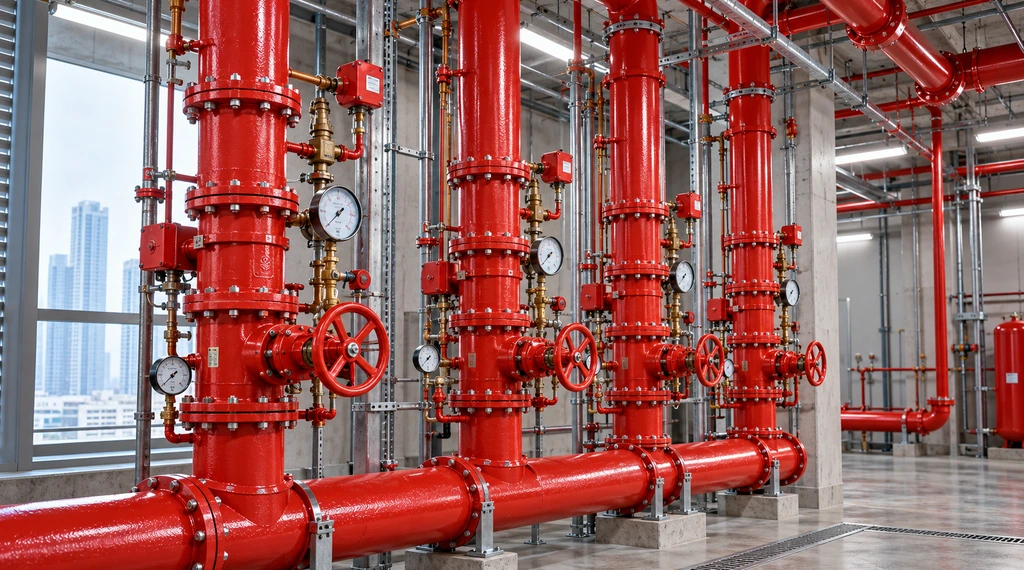
A fire pump adds energy to the water passing through it, increasing the pressure available to the connected fire-protection network. Depending on the design, that network may serve sprinklers, hydrants or other firefighting outlets. The pump works with a defined water source, driver, controller and piping arrangement; it does not create water or compensate for insufficient supply volume.
Flow and pressure must therefore be considered together. A pump that develops high pressure at low flow may not meet the system’s actual demand, while a source with sufficient stored water may still require pumping to overcome elevation and friction losses. Compare the hydraulic demand with the proposed pump curve and available supply rather than selecting equipment by motor power, discharge diameter or building height alone.
Which Fire Pump Types Should You Compare?
The following comparison groups pumps by construction, separating their physical arrangements before considering the driver or pressure-maintenance function. These are common options rather than an exhaustive list. Multistage designs and other configurations may also be relevant where the required duty or installation conditions call for them.
| Pump type | Main construction feature | Key selection question |
|---|---|---|
| Horizontal split-case | Split casing with a horizontal shaft arrangement | Is sufficient floor space available for the complete assembly and maintenance? |
| Vertical split-case | Split-case construction with a vertical arrangement | Can floor occupancy be reduced while preserving lifting and service access? |
| Vertical in-line | Vertical arrangement with suction and discharge connections in line | Does the compact layout suit the piping, supports and service clearances? |
| End-suction | Suction enters at the impeller end, with discharge through the casing | Does the proposed model meet the duty and installation constraints? |
| Vertical turbine | Submerged pumping assembly connected to a surface discharge head | Can suitable intake conditions and minimum submergence be maintained? |
The table identifies useful differences, but it does not establish that any particular model is suitable. Each candidate must still meet the hydraulic duty, source conditions and project requirements.
Horizontal Split-Case Fire Pumps
A horizontal split-case fire pump has a casing that separates to provide access to internal components. This construction can support maintenance access, although the procedure depends on the manufacturer’s design. It is a candidate where suitable suction conditions and adequate installation space are available; it should not be selected merely because the arrangement is familiar.
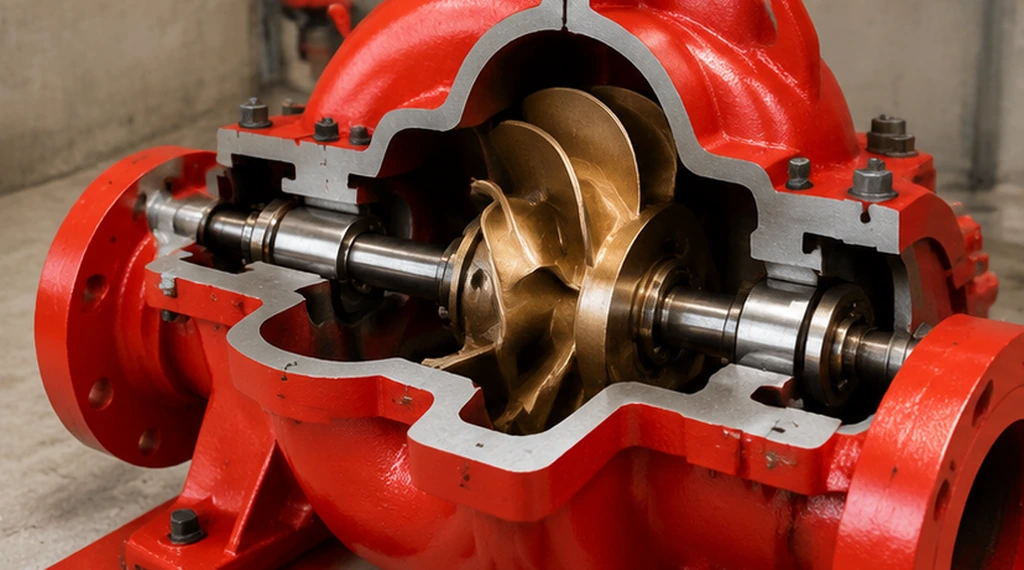
The layout assessment must include the driver, coupling, controller, valves and service areas. A pump may fit between two walls while leaving insufficient room to inspect the coupling or remove components. Review the general arrangement drawing alongside the maintenance instructions so that the proposed footprint represents a serviceable installation, rather than just the pump casing.
Vertical Split-Case Fire Pumps
Vertical split-case pumps retain split-case construction in a vertical arrangement. They may offer an alternative where floor space is constrained, provided the selected model meets the hydraulic requirements. Any reduction in floor occupancy must be considered alongside overhead clearance, driver removal and lifting provisions.
A vertical arrangement does not inherently make the equipment flood-resistant. Flood exposure depends on equipment elevation, drainage and the installation design. Although the motor’s position may change its exposure, that alone does not establish protection from water ingress. Assess the actual room conditions instead of treating orientation as a substitute for flood-protection measures.
Vertical In-Line Fire Pumps
Vertical in-line pumps position the suction and discharge connections along a common piping line, with the motor arranged vertically. Their compact footprint can be useful in restricted equipment rooms, but a small casing does not guarantee that the complete installation will fit. Valves, pipe connections, supports and access all contribute to the usable space required.
Support and servicing requirements are model-specific. Do not assume that every in-line pump requires no special support or that maintenance always involves dismantling the entire system. Check the manufacturer’s requirements for piping loads, mounting, lifting and component removal. A vertical in-line fire pump should be compared against these installation inputs before its compactness becomes a deciding advantage.
End-Suction Fire Pumps
An end-suction pump receives water at the impeller end and discharges it through the casing. It is another established centrifugal arrangement, with suitability determined by the particular model’s performance and installation requirements. Describing it simply as a pump for smaller buildings overlooks differences in system demand and water supply.
Compare the duty range, driver arrangement, connections and maintenance access for the proposed unit. A single-stage, single-suction fire pump provides a product category to investigate, rather than proof that every available rating suits the same application. Confirm the proposed equipment against the approved hydraulic requirements and layout.
Vertical Turbine Fire Pumps
Vertical turbine pumps use a submerged pumping assembly connected through a column to a discharge head above. They can be considered where source water lies below the pump mounting level, such as in a suitably designed tank, sump or well. This distinguishes them from arrangements that depend on suitable water conditions at an above-ground suction connection.
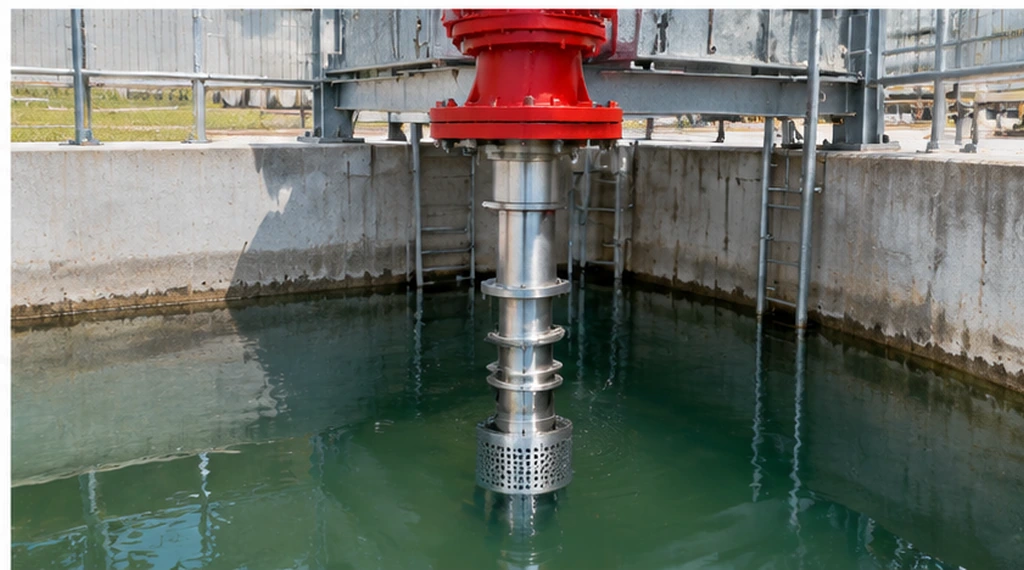
However, a vertical turbine does not eliminate inlet limitations. Minimum water level, submergence, intake geometry and source capacity remain important. Maintenance planning must also account for withdrawing the assembly. Assess the lowest operating water level rather than the full-tank condition, because an arrangement that works with full storage may not remain suitable as water is drawn down.
Electric, Diesel and Jockey Pumps: Different Classification Levels
Electric and diesel describe the driver rather than the hydraulic construction. Depending on the manufacturer and model, a split-case or vertical turbine arrangement may be available with different drivers. Driver selection follows the project’s power and operating requirements: electric packages require assessment of the supply and controller, while diesel packages introduce fuel, starting, ventilation and exhaust considerations.
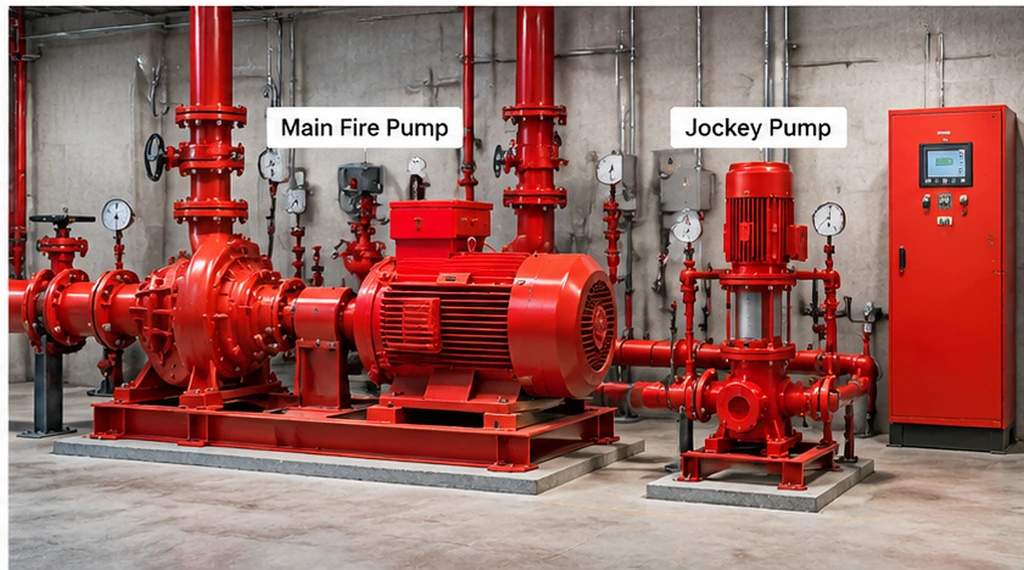
A jockey pump serves a different purpose. It restores small pressure losses under normal, non-fire conditions, helping prevent unnecessary starts of the main fire pump. It does not replace the main pump or supply the design firefighting flow. Its capacity and control settings must be coordinated with the system so that genuine demand initiates the required response. Frequent jockey-pump operation calls for investigation of leakage, controls and system conditions; it should not simply be accepted as normal cycling.
How Do You Choose Between Fire Pump Types?
Start with the water source and hydraulic duty, then use installation constraints to narrow the suitable arrangements. This sequence avoids choosing a compact or familiar model before establishing whether it can operate satisfactorily. The objective is a pump that meets the required performance from the available supply and remains accessible throughout its service life.
Match the Pump Arrangement to the Water Source
Establish the available flow, pressure and minimum operating water level before comparing models. A tank above the pump suction and a reservoir below the pump floor create different inlet conditions, even when both contain enough water. A vertical turbine may be a candidate for the latter arrangement, subject to intake and submergence checks. Other constructions require confirmation that their suction conditions meet the selected manufacturer’s requirements.
Use the limiting supply condition rather than a single favorable pressure reading or a full tank. Changes in source level or available pressure can affect the proposed arrangement. Review those conditions together with the hydraulic calculation so that the selected pump is evaluated against the demand it must actually serve.
Check the Complete Installation and Maintenance Space
Once source conditions have narrowed the options, compare the complete assembly with the room. Include connecting pipework, valves, controllers and the driver, together with access doors and lifting routes. A vertical arrangement may reduce floor occupancy while requiring more overhead access; a horizontal arrangement may occupy more floor area but provide a different servicing approach.
The manufacturer’s installation and maintenance drawings should determine the required clearances. Technicians need access to inspect connections and remove the components identified in the service procedure. If the layout does not permit that work, revise it or compare another arrangement rather than accepting equipment that merely fits inside the room.
Confirm Performance, Driver and Project Acceptance
Review the proposed curve against the required flow and pressure, including relevant supply variations. Check the resulting operating pressures against the connected system, then confirm the driver and controller arrangement. Any duty-and-standby configuration must address the actual dependencies of both units; adding another pump does not resolve a shared supply or installation limitation.
The datasheet, curve, arrangement drawing and manual should describe the same proposed equipment. Where certification is required, verify the exact pump, driver, controller and covered configuration. NFPA 20 applies where specified by the project; it is not the automatic basis for every international installation. Confirm the applicable national requirements, contract conditions and approval route before finalizing the selection. The fire sprinkler pipe guide provides related context for the connected piping network.
The final choice should connect a suitable source, verified hydraulic performance and a maintainable installation. To reduce equipment and document mismatches, share those inputs with Baolai Steel when reviewing the available pump range. Include the required flow, pressure, source conditions and approval documents in your fire pump inquiry.
Frequently Asked Questions About Fire Pump Types
Are there exactly four types of fire pumps?
No. The number depends on whether pumps are grouped by construction, orientation, driver or function. Compare like-for-like categories and identify the actual arrangement instead of treating a fixed number as a selection rule.
Does every high-rise building need the same fire pump?
No. Buildings of similar height can have different supplies, system demands and pressure arrangements. Pump selection follows the hydraulic design and applicable requirements, rather than a universal building-height threshold.
Can a general water pump replace a fire pump?
Not simply because it has similar flow and pressure figures. Fire service can impose specific requirements on the pump, driver, controller, performance and documentation. Evaluate any proposed substitution against those requirements before acceptance.
Sources
- NFPA — Fire Pump Basics: the pressure-boosting role of a fire pump.
- Armstrong Fluid Technology — Fire Pumps: construction categories and driver options.
- Pentair Aurora — Fire Pump Solutions: split-case and vertical turbine arrangements.
- Armstrong — Vertical In-Line Installation and Operating Instructions: installation, controls and operating considerations.
- Pentair Aurora — Vertical Turbine Specification: source-level and installation inputs.
- ASPE — Engineering Considerations for Stationary Fire Pump Installations: pressure-maintenance pump function.