ERW and HFW do not describe two completely separate, parallel pipe types. ERW, or electric resistance welding, is the broader process family. HFW, or high-frequency welding, identifies a resistance-welding route that uses high-frequency current to heat the strip edges before they are forged together. Because most modern resistance-welded pipe production uses a high-frequency route, the terms often overlap in commercial language, but they should not be treated as automatically interchangeable in a controlled specification.
The practical question is therefore not which label sounds more advanced. A buyer needs to know what the governing product standard means by each term, which process the mill actually uses, how the weld seam is controlled and tested, and whether the purchase order and material certificate describe the same product. This article follows that decision from terminology to supply evidence so that an apparent wording difference does not become a hidden order deviation.
ERW and HFW Are Related Terms, Not Two Parallel Pipe Types
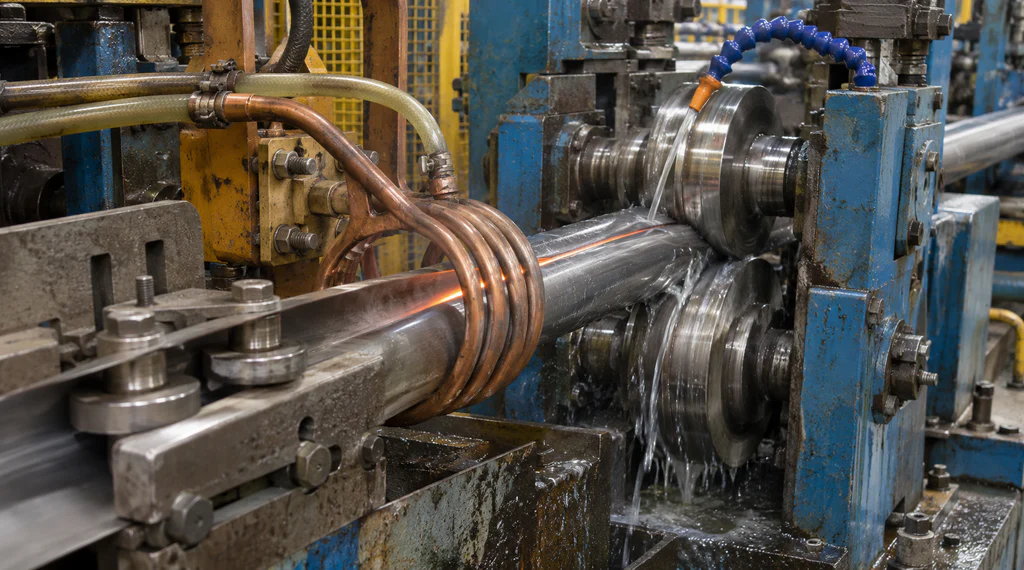
ERW describes a method in which a flat steel strip is progressively formed into a cylindrical shape, its longitudinal edges are heated by electrical resistance, and squeeze rolls forge the heated edges together. The joint is normally formed without adding filler metal. That process description distinguishes resistance-welded pipe from fusion-welded routes that use an arc and filler metal, but it does not by itself state the current frequency, product standard, grade, dimensions, or inspection level.
HFW adds a more specific process characteristic: high-frequency current supplies the welding heat. In this relationship, ERW is the family and HFW is a member or modern route within it. The distinction matters because an older document may use ERW as a general name, while another standard may use HFW to exclude low-frequency resistance welding. A catalogue may use ERW because customers recognize the term even when the production line uses high-frequency induction welding.
This is why a simple ERW-versus-HFW advantages table can mislead. It presents a broad category and one of its process routes as if they were competing products. Buyers first need the hierarchy, then the actual differences in welding route, standard definition, seam treatment, and test evidence. The welded steel pipe range provides the broader product-family context, while the ERW pipe category shows the commercial product family in which high-frequency welding is commonly used.
How HFW Differs From Earlier ERW Welding Routes
Electrical Frequency and Heat Concentration
In resistance welding, the current path generates heat at the strip edges. A high-frequency route concentrates the current near the surfaces and edges through electrical effects that become significant at high frequency. The edges can reach the required welding condition quickly, after which squeeze pressure expels oxides and forges the joint. Earlier low-frequency routes distributed the heat differently and are not the normal reference when a current specification expressly requires HFW.
Edge Heating and Forge Pressure
A supplier statement that a pipe is HFW does not reveal whether the ordered seam heat treatment, bead control, dimensional tolerance, or nondestructive examination has been completed. Those requirements come from the product standard and purchase specification. The process name is one input to the order, not a substitute for the full technical description.
HFI and High-Frequency Contact Welding
High-frequency power can be delivered by induction or by contacts. HFI usually refers to high-frequency induction, where the energy is coupled without direct electrical contacts on the strip. Contact welding transfers current through contact shoes. Both may fall within a broader high-frequency welding description, but the terminology used by a particular standard or mill procedure must be checked. A buyer should not silently convert HFI, HFC, HF-ERW, and HFW into one preferred abbreviation when the governing document distinguishes them.
Decide Whether ERW and HFW Can Be Treated as Equivalent for a Specific Order
Because standards and commercial documents can name the same process at different levels, equivalence must be decided from the document hierarchy rather than from the abbreviations alone. First identify how the governing product standard defines the welding route. Then check whether the project specification narrows that definition, whether the purchase order repeats the approved requirement, and whether the mill procedure and MTC use a compatible designation. A difference may be only editorial, but it becomes technical when it changes the permitted route, seam treatment, inspection scope, or approval basis.
Check the Governing Product Standard
Begin with the exact standard and edition named in the order. Confirm whether it permits resistance-welded pipe, whether it defines HFW separately, and whether the ordered grade and product level impose route-specific requirements. Do not rely on a general web definition when the contract contains its own definition. If the order cites multiple documents, establish which one controls when their terminology differs.
Confirm the Actual Welding Route
Ask the mill to identify the actual route rather than restating the sales description. Useful evidence can include the manufacturing procedure, process flow, mill capability statement, inspection and test plan, and MTC format. For a current line-pipe enquiry, an API 5L ERW steel pipe page can identify a possible supply route, but the page does not replace order-specific confirmation of the standard, grade, welding process, dimensions, and inspection.
Compare Weld-Seam Treatment and Testing
Next compare what the two descriptions require after welding. Depending on the governing standard and order, this may include seam heat treatment, weld flash control, flattening or bend tests, weld tensile testing, hydrostatic testing, electromagnetic or ultrasonic examination, dimensional checks, and visual inspection. The exact list must come from the adopted specification. The key is whether the proposed process and evidence meet the same acceptance basis, not whether the supplier can print HFW on a certificate.
Identify Any Project-Specific Restrictions
Some projects deliberately exclude an earlier welding route, require a defined frequency category, or add purchaser inspection. Others use ERW as an umbrella term and accept a documented HFW route. Record which situation applies. If definitions, process route, seam treatment, and test regime align, a terminology clarification may close the issue. If the standard expressly requires HFW and the supplier cannot identify the actual route, the material should not be accepted through a wording assumption.
Verify the Welding Route in the Supplied Pipe and Documents
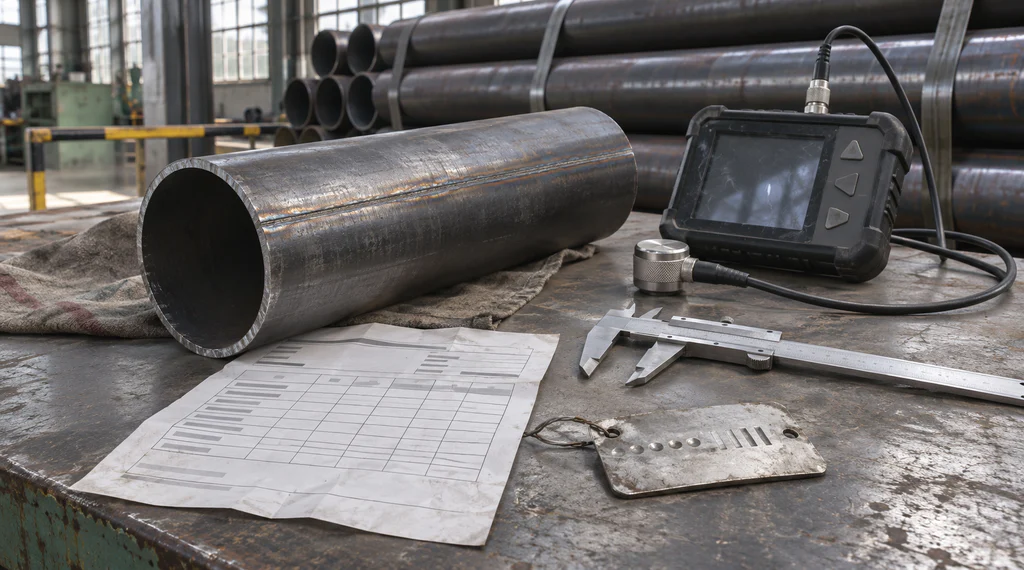
Once the technical basis is clear, verify the delivered product through a traceable chain: purchase order, approved specification, product standard, manufacturing declaration, MTC, pipe marking, and inspection records. The manufacturer, mill, grade, dimensions, heat or batch number, manufacturing route, and test results should describe the same supply. Multiple heats or split shipments need separate traceability rather than one generic certificate.
A certificate marked ERW may be acceptable when the order says HFW only if the applicable definitions and supporting mill evidence establish that the delivered pipe was produced by the required high-frequency route. A verbal statement is weaker than controlled documentation. Conversely, changing the MTC label to HFW without evidence does not cure a process mismatch. The disposition should preserve the original documents, the clarification, the reviewer’s decision, and any approved deviation.
If the route cannot be confirmed, place the affected batch on hold. If the route is confirmed but the standard, grade, dimensions, seam treatment, or test records do not match, treat the problem according to its actual technical significance. This prevents a terminology discussion from hiding a more important product or inspection difference.
Specify ERW or HFW Pipe Without Creating an Ambiguous Order
An effective order does not rely on one acronym. State the product standard and edition, grade, delivery condition, outside diameter and wall thickness, length, manufacturing route, required seam treatment, ends, coating, inspection and test scope, marking, document type, quantity, and destination. Where the controlling standard uses HFW, repeat that designation. Where ERW is retained as a commercial family name, require the supplier to declare the actual welding route.
The order should also state which documents require approval before production and which records must accompany the shipment. Any agreed terminology clarification should be referenced in the purchase order or approved deviation so that production, inspection, MTC preparation, and receiving inspection work from the same decision. Buyers who need the complete forming, welding, sizing, and inspection sequence can review the ERW pipe manufacturing process before defining mill-document requirements.
Review ERW and HFW Pipe Requirements With Baolai
Baolai can review the specified standard, edition, grade, dimensions, application, welding terminology, seam-treatment requirements, inspection scope, and destination against available welded-pipe routes and documents. This helps buyers identify whether an ERW/HFW wording difference is only a documentation issue or a technical mismatch before material is ordered. Visit Baolai for the broader product range, or send the controlling documents through the ERW vs HFW pipe enquiry route.
The final manufacturing route and any deviation remain subject to the contract, applicable standard, and authorized project approval. Supplying the original requirement and proposed wording allows the comparison to focus on the buyer’s real risk instead of producing a generic ERW definition.
ERW vs HFW Pipe FAQs
Does the welding frequency normally appear on the MTC?
Not always. The MTC may state ERW, HFW, HFI, or another manufacturing designation according to the product standard and mill document format. If frequency category is a contractual requirement, require the manufacturing route to be declared in the approved procedure, order, or supporting mill statement instead of assuming the MTC will show a numerical frequency.
Can older ERW pipe be substituted for a specification that requires HFW?
Not through terminology alone. Older low-frequency resistance-welded pipe may have a different process history from modern HFW pipe. Confirm the manufacturing route, product standard, seam treatment, inspection records, service history where relevant, and the project’s substitution procedure before considering acceptance.
What evidence should a buyer request when the standard says only ERW?
Ask for the mill’s declared welding route, applicable manufacturing procedure or process description, seam heat-treatment condition, inspection and test plan, MTC format, and batch-specific test records. These documents show what ERW means for the proposed supply and whether it satisfies any project restriction.
Does HFW determine the allowable pipe size or application?
No. Mill capability, forming equipment, product standard, grade, wall thickness, inspection level, and intended service determine the available range and suitability. HFW identifies a welding route; it does not independently approve a pipe for a particular pressure, structure, or pipeline duty.